

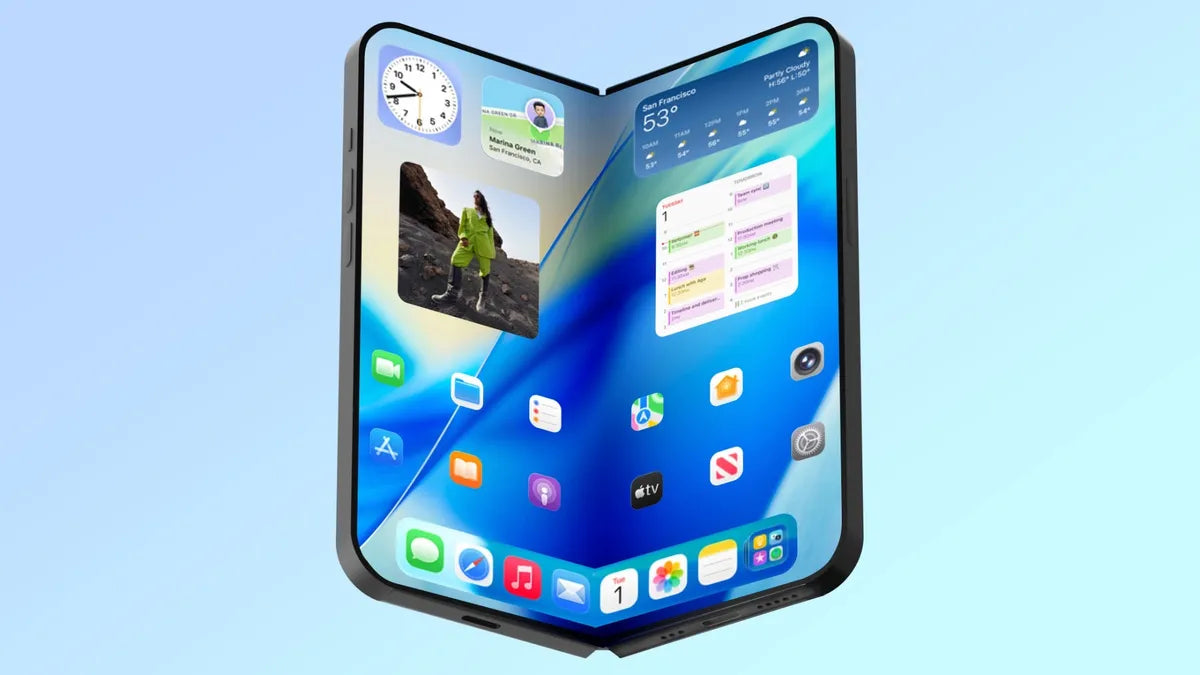
A foldable iPhone remains a rumour, but the question is already practical: would most iPhone owners genuinely enjoy living with a folding phone every day, or would the format’s compromises eventually outweigh the bigger screen. Consumer research and market data from the current foldable ecosystem suggest that plenty of buyers like the idea, try it, and then return to conventional premium phones when durability concerns, repair risk, and daily friction become harder to ignore.
Apple has not announced a foldable iPhone. Recent reporting and analyst commentary still point to a possible 2026 introduction, but availability and production scale are uncertain and could extend into 2027.
The strongest evidence is not opinions, it is what buyers do after upgrading
One of the clearest signals about foldable satisfaction comes from what owners choose next.
Kantar’s Worldpanel ComTech analysis published in September 2023 found foldables made up about 1 percent of smartphones owned across several major markets, and it reported a loyalty problem: among foldable owners who upgraded their phone in the prior 12 months, 55 percent moved back to a conventional smartphone.
That does not prove that all foldable owners regret their purchase, and it does not cover every region or brand. It does show that a majority of recent upgraders in that sample did not stick with the format, even when they continued buying premium models such as top tier Samsung, Google and iPhone devices.
Kantar also reported foldable owners cited lower satisfaction than super premium non foldable owners in areas that usually decide long term happiness: battery life, after care support, and how often software updates arrive.
Foldables are improving, but the category still has not gone mainstream
The industry keeps pushing foldables forward, yet adoption remains narrow and growth is uneven.
Counterpoint Research reported in late 2024 that DSCC data suggested the foldable smartphone display market had stalled, with demand around 22 million panels, limited growth in 2024, and a decline forecast for 2025.
IDC has been more optimistic about longer term shipments, but it still framed the next phase of growth as dependent on solving the two concerns that have historically held consumers back: durability and price.
This matters for a hypothetical foldable iPhone because Apple’s mainstream audience tends to reward devices that feel low friction over years, not devices that require extra rules and extra caution.
The “regret” moment usually arrives when the hinge meets real life
Foldables offer a genuine benefit: a larger screen you can close and pocket. The regret, when it happens, often starts as low grade anxiety about damage and cost.
Manufacturers themselves acknowledge the handling burden. Samsung’s UK support guidance for Galaxy foldables says the devices “need some extra care and maintenance” and lists precautions that are simply not part of normal slab phone ownership, such as avoiding sharp objects, avoiding pressure, and keeping foreign objects away from the folding area.
Independent repairability analysis points to structural reasons for that caution. iFixit has said foldable inner screens are delicate and that the mechanical hinge introduces additional avenues for dust and liquid ingress that may eventually become a problem.
Even water and dust ratings can be misunderstood. Samsung explains that the Galaxy Z Fold6 and Flip6 have an IP48 rating, and notes the testing conditions for water resistance. At the same time, coverage has cautioned that this does not mean “dust proof” in the way many consumers interpret it, and the hinge remains a vulnerability in dusty environments.
Then there is repair exposure. TechRadar reported that the Pixel 9 Pro Fold inner screen repair part was listed at $1,199.99 in the US and £1,127.99 in the UK, citing iFixit listings. That is not a Samsung price and not an Apple price, but it illustrates the broader reality: foldable inner displays can be extraordinarily expensive compared with typical phone repairs.
What a foldable iPhone would need to fix to feel like a normal iPhone
If Apple launches a foldable iPhone, it will be judged against the expectation that an iPhone should feel dependable and predictable.
Current reporting suggests Apple’s internal challenge list likely overlaps with the market’s pain points. Recent coverage has highlighted ongoing technical hurdles around achieving a truly crease free foldable display, which remains one of the most visible reminders that the device is not a standard phone screen.
There is also the question of supply and scale. Recent reporting of analyst commentary suggested production challenges could constrain availability into 2027, which would be consistent with the idea that manufacturing a foldable at iPhone volumes is significantly harder than building a conventional slab device.
Design rumours point toward a book style device with a wider inner aspect ratio similar to an iPad like 4:3 footprint. That could be excellent for reading, email, and creative work. It also reinforces the reality that a foldable iPhone is not just an iPhone that bends. It is a different product category that changes how content fits, how it is held, and how fragile the core screen may feel.
A practical decision framework before you chase the foldable iPhone hype
For most people, the right question is not whether a foldable looks impressive. It will. The right question is whether the inner screen solves a daily problem.
A foldable is more likely to be a good purchase if these conditions are true:
-
The larger screen will be used every day for reading, spreadsheets, messaging, or multitasking, not only as an occasional novelty.
-
The buyer is comfortable following extra handling precautions similar to what manufacturers publish for today’s foldables.
-
The buyer is comfortable paying for premium coverage, or is willing to accept the financial risk of high cost inner screen repairs seen across the foldable category.
-
The buyer expects a first generation product to involve compromise, including visible crease behaviour in many current foldables and potential supply constraints if Apple launches in limited volume.
For everyone else, waiting is not cautious, it is rational. The best evidence from consumer tracking suggests many foldable owners who upgrade do not stay foldable, and the market data suggests the category is still working through durability and price barriers before it becomes an obvious default.
Share:
Should you use an iPhone camera lens protector
Are iPhone cases still relevant for the iPhone 17 Pro Max?